



EITimes | Flagship Strategic Analysis
Africa is attracting renewed investment into critical minerals, offshore energy and strategic infrastructure. Yet the continent’s ability to convert resource potential into bankable projects remains constrained by political uncertainty, infrastructure deficiencies, financing costs and fragmented risk-management capacity. As global capital becomes more selective, insurance must move beyond asset protection to become a strategic instrument of investment mobilisation.
The investment opportunity is expanding. So is the risk.
Africa’s resource economy is entering a consequential investment cycle.
From Namibia’s emerging offshore petroleum frontier to the Democratic Republic of Congo’s strategic position in global copper and cobalt supply chains, international investors are paying renewed attention to the continent’s energy and mineral endowment.
Governments are pursuing domestic processing, regional infrastructure integration and greater participation in global critical-minerals value chains. Development finance institutions are experimenting with new guarantee structures. Private investors are exploring opportunities across conventional energy, renewable power, mining and associated infrastructure.
But beneath this investment momentum lies a structural contradiction.
Africa has substantial natural resources, considerable infrastructure requirements and a growing pipeline of investment opportunities. Yet the systems required to make these opportunities commercially viable remain unevenly developed.
Political and regulatory uncertainty can undermine investment assumptions. Inadequate power supply can compromise mining economics. Transport bottlenecks can disrupt commodity exports. Currency restrictions can constrain debt servicing and dividend repatriation. Security incidents, environmental liabilities and contractual disputes can threaten project continuity.
These are not peripheral considerations. They directly influence the cost of capital, financing conditions, insurance availability and the willingness of investors to commit long-term resources.
The central question for Africa’s energy and extractive industries is therefore changing.
It is no longer simply whether the continent can attract investment. It is whether African projects can demonstrate sufficiently credible risk-management frameworks to secure that investment on commercially sustainable terms.
This is where insurance assumes a much more strategic role.
Insurance must be understood not merely as a mechanism for compensating losses after an incident, but as part of the wider architecture through which investment risks are identified, allocated, mitigated and financed.
For Africa, that distinction could determine which projects proceed, which attract international capital and which remain stranded opportunities.
The capital gap is also a risk gap
Africa’s infrastructure financing challenge is well established. However, the relationship between infrastructure deficits and insurability deserves much greater attention.
The International Energy Agency’s World Energy Investment 2025 provides an important indication of the scale and distribution of the challenge.
Approximately 600 million people in Africa still lack access to electricity, while more than one billion lack access to clean cooking. South and North Africa account for more than 45% of the continent’s energy investment, despite representing less than 20% of its population.
The composition of investment is also changing. Private-sector investment in clean energy increased from approximately US$17 billion in 2019 to almost US$40 billion in 2024. Meanwhile, public and development finance for African energy projects declined by approximately one-third over the preceding decade, reaching around US$20 billion in 2024.
These figures reveal two simultaneous developments: rising private-sector clean-energy investment and continuing dependence on effective public and development-finance intervention.
For project developers, the implications are significant.
Energy and extractive projects are capital-intensive, long-duration investments. Their commercial viability depends on assumptions about production, commodity prices, infrastructure availability, regulatory stability and the reliability of counterparties.
Where these assumptions become uncertain, lenders and equity investors demand additional protection.
That protection may take the form of higher financing margins, additional collateral, stronger contractual safeguards, political risk cover, guarantees or revised investment structures.
In some circumstances, the project may not reach financial close at all.
The relationship between risk and capital is therefore direct: poorly understood or inadequately mitigated risks can make otherwise attractive projects commercially unattractive.
Insurance cannot eliminate these structural constraints. It can, however, help transfer defined exposures, improve risk allocation and provide lenders and investors with greater confidence in the project’s ability to withstand specified adverse events.
The distinction matters. A project with substantial mineral reserves is not necessarily a bankable project. Geological potential must be supported by credible infrastructure, sound governance, viable economics and an acceptable risk-financing structure.
The missing link in many African investment propositions is the ability to translate resource potential into commercially viable, institutionally credible and properly risk-structured projects.
Insurance is an important component of that process, but it must operate alongside infrastructure development, sound governance, reliable institutions and sustainable financing.
Critical minerals: The investment opportunity is being tested by execution risk
Africa’s critical-minerals opportunity illustrates this challenge particularly clearly.
The continent occupies strategically important positions in global cobalt, copper, manganese, graphite and other mineral supply chains. Yet possessing these resources does not automatically translate into exploration investment, downstream processing capacity or reliable export infrastructure.
The OECD’s 2026 analysis, Critical Minerals in Africa, highlights a particularly important investment imbalance.
Africa’s share of global mineral exploration investment declined from 16% in 2004 to approximately 10.4% in 2024, despite the continent accounting for 20% of new mineral discoveries.
The OECD identifies political instability, armed conflict, resource nationalism and unpredictable regulatory environments among the factors discouraging exploration investment.
The implications extend beyond mining companies.
Exploration is the foundation of the future mining pipeline. When junior exploration companies cannot secure capital or appropriate risk protection, potential discoveries may never progress into commercially viable projects.
This creates a broader challenge for insurers, reinsurers and investment institutions.
The risk profile of a mineral project changes as it moves from exploration to development, construction, production and eventual closure. Each stage requires different technical expertise, capital commitments and insurance solutions.
Exploration involves geological uncertainty and potentially significant drilling exposures. Construction introduces engineering, contractor, delay and equipment risks. Production brings machinery breakdown, environmental liability, business interruption, political risk and logistics exposure.
A fragmented insurance approach can leave critical gaps between these stages.
The opportunity is for insurers and brokers to develop more integrated risk-advisory and insurance programmes that support projects throughout their lifecycle.
However, this requires credible technical information, competent risk engineering, reliable project governance and underwriting expertise. Insurance cannot substitute for these fundamentals.
Case study: The DRC and the gap between strategic agreements and bankable projects
The Democratic Republic of Congo offers a useful illustration of the execution challenge.
The country is central to global cobalt supply and is an important copper producer. Its mineral endowment has attracted increasing geopolitical and commercial attention as major economies seek to diversify critical-mineral supply chains.
Yet the investment challenge extends well beyond access to mineral deposits.
Electricity availability, transport infrastructure, political stability, security and domestic processing capacity remain essential to translating mineral resources into economic value.
In November 2026, the DRC urged the United States to translate its strategic minerals partnership into tangible investments. Economy Minister Daniel Mukoko Samba emphasised domestic processing, improved electricity access and stability in the country’s eastern regions.
The partnership’s joint steering committee reported growing private-sector interest and an expanding investment pipeline. However, the announcement did not establish new financing commitments or specific newly approved projects.
That distinction is important.
A strategic partnership is not a financial close. An investment pipeline is not a funded project. A proposed infrastructure corridor is not an operational supply chain.
For insurers and investors, the DRC illustrates the importance of assessing interconnected exposures rather than treating mining assets as isolated risks.
A producing mine depends on reliable electricity, transport, security, export arrangements and contractual counterparties. A disruption affecting one component can have consequences throughout the value chain.
The commercial question is therefore not simply whether the mine can be insured.
It is whether the supporting infrastructure, logistics and operating environment can be sufficiently protected and financed to sustain production.
Offshore energy: International capital is arriving with more sophisticated risk requirements
The same challenge is evident in Africa’s offshore energy sector.
Namibia has emerged as an important frontier for international exploration interest. Its offshore petroleum potential has attracted established international operators and national energy companies seeking exposure to future discoveries.
In November 2026, QatarEnergy agreed to acquire a 25% participating interest in Petroleum Exploration Licence 82 (PEL82) from a Chevron subsidiary.
Upon completion, Chevron will retain its 55% operatorship, while QatarEnergy will hold 25%, and NAMCOR E&P and Custos Energy will each hold 10%.
The agreement, which remains subject to regulatory approvals, covers approximately 11,444 square kilometres offshore Namibia, in water depths ranging from 350 to 2,300 metres.
The transaction is significant because it illustrates the continuing international interest in Namibia’s offshore exploration opportunities and the importance of partnerships in allocating capital and project exposure.
But offshore exploration also introduces a complex risk environment.
Deepwater drilling, subsea infrastructure, well-control incidents, environmental liabilities, marine logistics and equipment failures can produce losses that exceed the capacity of individual insurers.
The relevant insurance architecture may include:
- Control of well and operators’ extra expense.
- Offshore construction and installation all-risks.
- Property damage and machinery breakdown.
- Third-party liability and environmental liability.
- Hull and machinery and protection and indemnity.
- Business interruption and delay in start-up.
These products are not interchangeable, and coverage depends on policy wording, insured interests, exclusions, limits and the specific risk profile.
The allocation of responsibilities between operators, participating partners and contractors is equally important.
A well-structured joint venture should establish who bears particular liabilities, how insurance is arranged, how deductibles are allocated and how claims are handled across the operating partnership.
For African national oil companies and local energy businesses, participation in these arrangements presents an opportunity to build technical and financial capacity.
However, local participation must be supported by the ability to understand, negotiate and manage complex contractual and insurance obligations.
Otherwise, ownership participation can increase exposure without necessarily increasing the capacity to manage that exposure.
International joint ventures and project partnerships should therefore create opportunities for structured knowledge transfer, technical collaboration and the development of local risk-management capabilities. African participation should progressively extend beyond equity ownership to include meaningful involvement in project governance, technical decision-making, contractual risk allocation and insurance programme design.
The guarantee market is demonstrating what risk mitigation can unlock
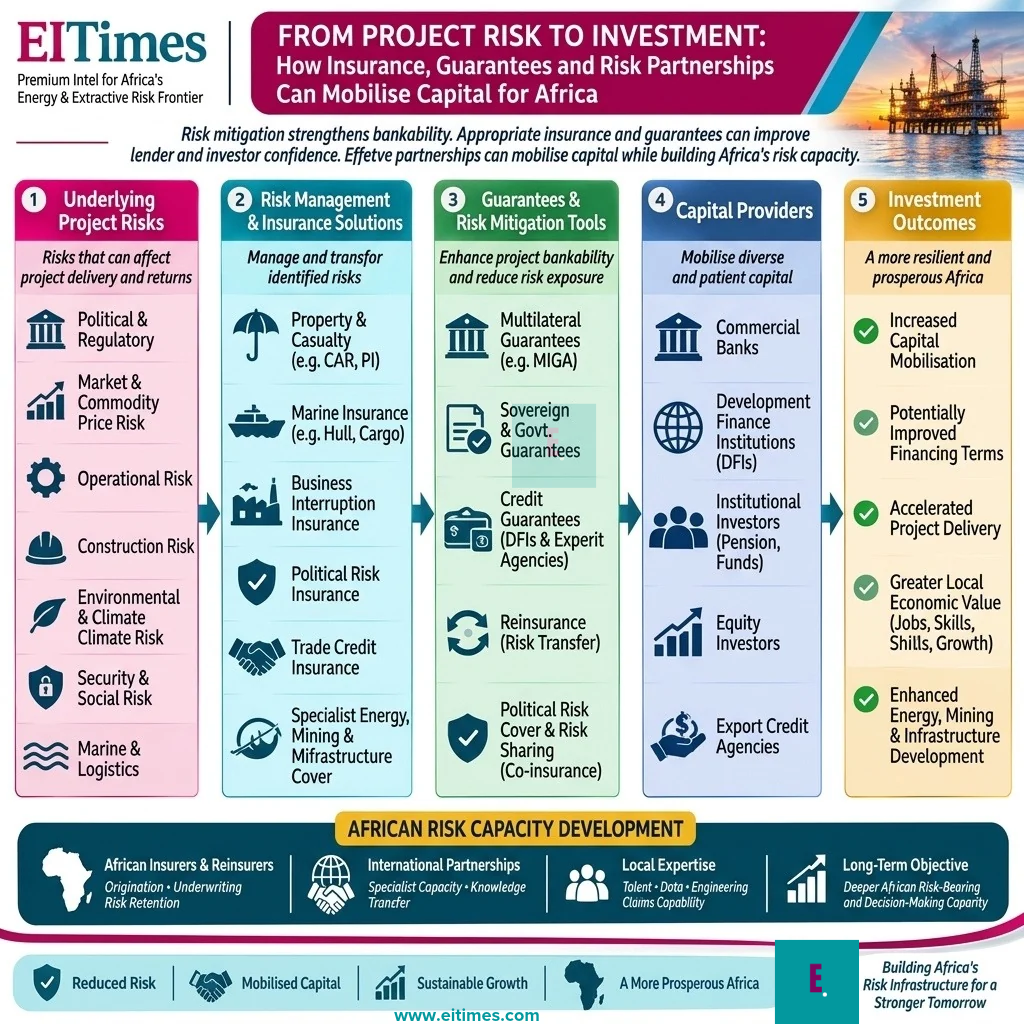
Source: EITimes.
One of the most important developments in investment risk management is the expanding use of political risk insurance, credit enhancement and multilateral guarantees.
These instruments are particularly relevant where commercial investment is constrained by risks that individual companies cannot adequately control.
Political risk insurance can cover specified non-commercial exposures, including expropriation, currency inconvertibility and transfer restrictions, war and civil disturbance, and breach of contract, subject to the applicable policy or guarantee terms.
Credit enhancement can improve the credit profile of a project or financing arrangement, while guarantees may address specific obligations of governments or public-sector counterparties.
The Multilateral Investment Guarantee Agency (MIGA), part of the World Bank Group, provides a practical illustration of the scale of this market.
Its 2025 annual reporting recorded US$9.5 billion in new guarantees across 44 projects during fiscal year 2025, a record at the time.
The agency reported that these commitments were expected to mobilise US$9.8 billion in private capital.
Its outstanding gross guarantee portfolio reached US$36.8 billion at 30 June 2025. MIGA also ceded US$7.1 billion of new business to the reinsurance market during that financial year, demonstrating how reinsurance supports the expansion and diversification of guarantee capacity.
The momentum continued into fiscal year 2026, when MIGA’s new guarantee business reached US$10.6 billion across 60 projects, with its gross outstanding guarantee portfolio increasing to US$41.4 billion.
This is an important point for African insurers.
Risk transfer does not have to end with the primary insurer or guarantee provider. Reinsurance and co-insurance arrangements allow large exposures to be distributed across multiple balance sheets and markets.
For complex energy and mining projects, such structures can be critical to obtaining sufficient limits and managing accumulation.
Beyond providing additional financial capacity, international reinsurance partnerships can support the transfer of technical knowledge, underwriting expertise, risk engineering practices and claims-management capabilities. For African markets, the opportunity is to develop partnerships that deliver more than transactional capacity, progressively strengthening local institutions and their ability to participate meaningfully in complex risk programmes.
Case study: MIGA and AMEA Power’s portfolio guarantee framework
In April 2026, MIGA announced a framework agreement with AMEA Power to support up to 23 renewable energy and battery-storage projects across Africa, the Middle East and Central Asia.
The framework provides for guarantees of up to US$1.48 billion, supporting approximately US$1.65 billion in equity, quasi-equity and shareholder-loan investments.
The wider framework covers ten countries across Africa, the Middle East and Central Asia, including Côte d’Ivoire, Djibouti, Egypt, Ethiopia, Jordan, Kenya, South Africa, Togo, Uganda and Uzbekistan.
The guarantees can provide up to 15 years of protection against specified political risks, including currency inconvertibility and transfer restrictions, expropriation, war and civil disturbance, and breach of contract.
The programme is particularly instructive because it moves beyond the conventional approach of assessing every project entirely in isolation.
By grouping multiple projects and technologies under one framework, the structure seeks to improve diversification, streamline underwriting and reduce execution timelines.
For African markets, this is a potentially important model.
It demonstrates how risk mitigation can be incorporated into investment planning rather than introduced only after financing difficulties emerge.
It also illustrates the complementary roles of development finance institutions, commercial investors and insurance or guarantee providers.
The lesson is not that every African project requires a multilateral guarantee. Rather, it is that carefully designed risk-sharing structures can improve the conditions under which private capital enters markets that would otherwise be considered difficult to finance.
Africa’s insurance market: Capacity, concentration and the reinsurance question
The expansion of African energy and extractive investment raises an uncomfortable question.
Does the continent’s insurance market have the technical expertise, financial strength and risk-bearing capacity required to support the next generation of major projects?
The OECD’s Africa Capital Markets Report 2025 offers important context.
It estimates African insurance penetration at approximately 3.5% of GDP, compared with a global average of approximately 7%.
The report also identifies significant concentration in the insurance market: South Africa, Morocco, Egypt, Kenya and Nigeria accounted for approximately 87% of African insurance premiums in 2023.
These figures describe the overall insurance market, not the specialist energy and mining underwriting segment. They should therefore not be interpreted as a direct measure of available industrial risk capacity.
Nevertheless, they demonstrate the structural differences between African insurance markets and the scale of the continent’s wider economic ambitions.
Large energy, mining and infrastructure projects require specialist underwriting, actuarial modelling, engineering assessment, claims management and access to substantial reinsurance capacity.
In many jurisdictions, local insurers participate in major programmes but retain only a relatively small portion of the total exposure, with the balance transferred to international reinsurers.
That arrangement is not inherently problematic. Reinsurance is a fundamental mechanism for distributing risk and protecting insurer solvency.
The strategic question is whether African insurers can build sufficient expertise, financial strength and market influence to participate more meaningfully in the development, structuring and placement of these risks.
The answer will require more than higher capital requirements.
It requires investment in specialist underwriting teams, engineering capabilities, exposure analytics, accumulation management, claims expertise and relationships with international reinsurance markets.
It also requires stronger cooperation between insurers, brokers, energy companies, mining operators and regulators.
The ambition should extend beyond increasing the proportion of premiums retained locally. Africa needs stronger institutions capable of originating, structuring, underwriting and managing complex risks, while developing the financial strength to retain appropriate exposures.
International reinsurance should remain an important source of capacity, technical expertise and capital partnership. The objective is not to replace international markets, but to establish more balanced relationships in which African institutions progressively participate in the creation, pricing, management and distribution of risk.
This requires deliberate investment in specialist talent, technical infrastructure, exposure data, underwriting expertise and institutional partnerships. Local participation should be measured not only by the volume of premiums retained, but also by the depth of expertise, decision-making influence and sustainable capacity developed within African markets.
Nigeria’s reform opportunity
Nigeria offers a relevant policy example.
The Nigerian Insurance Industry Reform Act 2025 introduces a strengthened regulatory framework, including higher capital requirements and a risk-based approach to capital adequacy.
The wider objective is to improve financial resilience, strengthen policyholder protection and support the development of a more capable insurance industry.
Nigeria’s insurance market has now moved beyond the legislative phase of reform. In August 2026, NAICOM announced the completion of the sector’s recapitalisation exercise, with 43 insurance and reinsurance companies initially confirmed as meeting the revised minimum capital requirements. The Commission subsequently commenced issuing new licences to compliant operators, marking an important stage in the implementation of NIIRA 2025.
For Nigeria’s energy and extractive sectors, the opportunity is to translate regulatory reform into greater specialist capacity.
Higher capital alone will not automatically create deepwater underwriting expertise or increase the amount of energy risk that domestic insurers can retain.
That requires deliberate market development, technical investment and access to appropriate reinsurance support.
Nigeria’s position as a major African energy market gives it an opportunity to develop a more sophisticated specialist insurance ecosystem, provided that regulatory improvements are accompanied by commercial and technical progress.
Infrastructure is the exposure that connects everything
Perhaps the most underestimated dimension of Africa’s investment risk is the interconnected nature of infrastructure.
A mine depends on electricity, water, roads, railways, ports and export corridors. An offshore petroleum development depends on vessels, logistics bases, pipelines, processing facilities and export terminals.
These assets are often financed, owned and operated by different entities, sometimes across multiple jurisdictions.
Their risks are interconnected, but their insurance arrangements may not be.
This creates the possibility of coverage gaps, disputes over liability and business interruption exposures that extend beyond the boundaries of individual insured assets.
Consider the Lobito Corridor, which connects mineral-producing areas in Central Africa to Angola’s Atlantic coast.
Its strategic significance is not simply the movement of minerals. It is the potential to improve supply-chain access, reduce logistical constraints and strengthen the commercial viability of regional mining investment.
But a transport corridor is only as reliable as its weakest critical component.
Railway disruption, port congestion, political instability, infrastructure damage and security incidents can affect the ability of mining companies to fulfil supply contracts and generate export revenues.
For the insurance sector, this calls for a more integrated approach to infrastructure risk.
Property damage insurance for individual assets is important, but it does not necessarily resolve the wider financial consequences of disruption across a supply chain.
Project sponsors and insurers must consider contingent business interruption, contractual dependencies, political violence, marine cargo exposures and the availability of alternative transport routes.
This is where risk engineering and insurance advisory services can become more strategically valuable.
The objective should be to identify critical dependencies before construction and operations, rather than discovering their significance after a major disruption.
Project bankability should not be assessed solely by the ability to attract financing or satisfy international investment requirements. It should also consider the economic value created within host countries.
For resource-rich African economies, this includes domestic value addition, local enterprise participation, employment and skills development, technology transfer, infrastructure access and the responsible management of environmental and closure liabilities.
A commercially viable project should be capable of generating sustainable returns for investors while contributing meaningfully to the economic development of its host country. These objectives should reinforce one another rather than be treated as competing priorities.
The next frontier: Making insurance part of project development
Africa’s investment challenge cannot be resolved by insurance alone.
Insurance cannot create political stability, guarantee electricity supply, build railways or eliminate regulatory uncertainty.
Nor should governments treat insurance as a substitute for institutional reform and responsible project governance.
However, insurance can contribute to a broader investment-enablement framework.
That requires bringing insurers and risk specialists into project development much earlier.
Too often, risk financing is treated as a procurement exercise undertaken shortly before construction or commercial operations.
A more effective approach would integrate risk assessment and insurance structuring into the earliest stages of project preparation.
This should include:
1. Risk identification before financial close
Project sponsors should undertake detailed assessments of political, operational, environmental, construction, marine and infrastructure exposures before financing structures are finalised.
2. Clear contractual allocation
Governments, developers, contractors, operators and lenders should establish who is responsible for specific risks, how liabilities are allocated and which exposures can be transferred through insurance.
3. Appropriate insurance and guarantee structures
Commercial insurance, political risk cover, credit enhancement, development finance guarantees and reinsurance should be evaluated as complementary instruments rather than competing solutions.
4. Stronger African underwriting participation
Local insurers should build specialist capabilities, participate in complex placements and strengthen their relationships with international reinsurers.
5. Better infrastructure and supply-chain risk management
Projects should assess the resilience of power, transport, logistics and export infrastructure as part of their overall investment and insurance strategy.
6. Stronger public-private coordination
Governments, regulators, development finance institutions and private insurers should collaborate on frameworks that improve the quality and predictability of project risks.
These measures will not remove all investment barriers. They can, however, improve the quality of projects presented to capital providers and strengthen the ability of investors to assess and manage their exposures.
The strategic choice facing Africa
The next phase of Africa’s energy and extractive development will be shaped by more than the availability of mineral deposits, petroleum reserves or renewable energy resources.
It will be shaped by the ability to deliver projects reliably, maintain infrastructure, manage political and operational risks, secure long-term financing and protect capital against defined adverse events.
The OECD’s critical-minerals research reinforces this point: policy and regulatory conditions, infrastructure and financing constraints can be as decisive as geology in determining whether mineral resources translate into investment and value addition.
The DRC’s demand for tangible outcomes from strategic minerals partnerships illustrates the execution gap.
Namibia’s offshore investment activity demonstrates the continued attraction of the continent’s resource opportunities.
MIGA’s guarantee programmes show that risk mitigation can help mobilise private capital when structured appropriately.
Taken together, these developments point to an important conclusion.
Africa’s investment competitiveness will increasingly depend on the quality of its risk infrastructure.
For insurers and reinsurers, this represents an opportunity to move closer to the centre of project development and investment decision-making.
For governments, it is a reminder that investor confidence depends on more than resource access and fiscal incentives. It requires credible institutions, reliable infrastructure and predictable rules.
For investors and lenders, the imperative is to evaluate projects through a more integrated understanding of risk, rather than treating individual assets as isolated opportunities.
And for African insurance markets, the challenge extends beyond accessing international capacity. It is to develop stronger institutions, technical expertise and sustainable risk-bearing capabilities that enable African markets to participate more meaningfully in the origination, structuring, underwriting and management of complex risks. International partnerships should be an important part of this development, supporting knowledge transfer, capital mobilisation and the progressive strengthening of African risk infrastructure.
The continent does not need insurance to promise that projects will never fail. It needs insurance markets capable of identifying, pricing, transferring and managing risks with greater sophistication.
That is how insurance can contribute to investment confidence.
That is how risk financing can support project bankability.
And that is how Africa can begin converting its considerable resource potential into sustainable economic value.
The next African resource advantage may not be what lies beneath the ground. It may be the quality of the risk infrastructure built around it.
EITimes executive intelligence | What decision-makers should take away
| Stakeholder | Strategic imperative |
|---|---|
| Governments and regulators | Improve regulatory predictability and create investable risk environments. |
| Energy and mining companies | Integrate risk engineering and insurance into project design and financing. |
| Insurers and reinsurers | Build specialist technical capacity and deepen participation in complex project risks. |
| Brokers and risk advisers | Move upstream into project structuring and risk advisory. |
| Banks and development finance institutions | Use guarantees and risk-transfer structures to address identifiable investment constraints. |
| Institutional investors | Evaluate the quality of project risk governance alongside financial returns. |
Sources and further reading
The analysis draws on institutional research, development-finance disclosures, government announcements and international reporting.
- Organisation for Economic Co-operation and Development (OECD). Critical Minerals in Africa (2026). Exploration investment, resource nationalism, policy uncertainty, infrastructure and value-addition constraints. Read the report.
- International Energy Agency (IEA). World Energy Investment 2025: Africa. Energy investment distribution, electricity access and private-sector clean-energy investment. Read the report.
- World Bank Group — Multilateral Investment Guarantee Agency (MIGA). MIGA Annual Report 2025. Guarantee issuance, private-capital mobilisation and reinsurance activity. Read the report.
- World Bank Group — MIGA. Portfolio of Guarantees Pushes MIGA’s Total Issuance Over US$100 Billion (9 April 2026). MIGA and AMEA Power’s multi-country renewable energy and storage portfolio guarantee framework. Read the announcement.
- Organisation for Economic Co-operation and Development (OECD). Africa Capital Markets Report 2025. Insurance penetration, insurance-market concentration and institutional capital. Read the report.
- Economic Community of West African States (ECOWAS). ECOWAS Convenes Final National Experts Review Meeting on Revised Regional Mineral Development Policy in Lagos (30 October 2026). Emerging policy priorities in critical minerals, mine security, occupational safety and environmental, social and governance standards. Read the announcement.
- Qatar News Agency (QNA). QatarEnergy Acquires 25% Interest in Namibian Offshore Exploration Licence (9 November 2026). PEL82 transaction details and participating interests. Read the report.
- Reuters. Congo Says US Minerals Deal Should Be Judged by Projects, Not Signed Deals (6 November 2026). Project execution, domestic processing and infrastructure priorities. Read the report.
Editorial disclosure
Figures refer to the reporting periods stated in their respective sources and should not be treated as current-year market estimates unless explicitly identified as such.
MIGA guarantees and commercial insurance policies are distinct instruments with different coverage terms. The analysis does not imply that all project risks are insurable or that guarantees automatically ensure financial close.
